Look, sourcing auto parts overseas isn't exactly a walk in the park. If you've been in the B2B auto parts game for more than a minute, you know exactly what I'm talking about. You go online, search for a supplier, and suddenly you're drowning in hundreds of companies claiming to be the "leading manufacturer" of wholesale car headlights.
Most of them are lying.
A good chunk of the companies you talk to on B2B platforms are just trading companies sitting in an office building, passing your order to the cheapest factory they can find and taking a 30% cut. I’ve spent years navigating supply chains and walking dusty factory floors to figure out who actually makes the stuff and who just flips it.
The automotive lighting market is massive. A recent report by Fortune Business Insights pegged the global auto lighting market at around $38 billion, and its climbing steadily towards $57 billion by 2030. That means there is a ton of money to be made if you get your sourcing right, but also a ton of money to lose if you buy garbage inventory.
Today we are going to break down how sourcing automotive lighting actually works in 2026. No fluff, no generic "buy low sell high" nonsense. Just the raw reality of finding reliable bulk auto headlamps, cutting out the leeches, and keeping your margins fat.
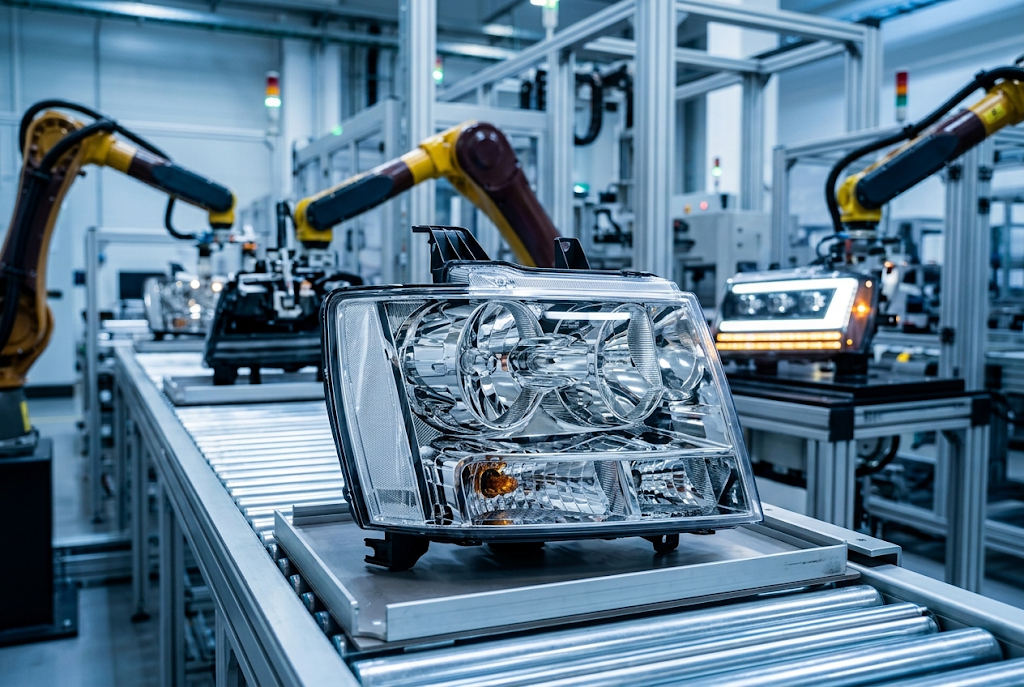 The Controversial Truth About the Auto Lighting Market
Everyone on LinkedIn and industry forums is obsessing over the newest laser headlights, adaptive matrix LED systems, and crazy RGB custom builds.
Here is my controversial take: if you are a standard auto parts distributor, a collision repair chain, or a parts wholesaler, chasing those high-tech lights is a great way to go broke. The failure rates are higher, the technical support you have to provide is a nightmare, and the warranty claims will eat your profits alive.
You know where the real, quiet, massive money is?
Replacement headlights for 10 to 15-year-old trucks and commuter cars. Vehicles like the Chevy Silverado, Ford F-150, Honda Accord, and Toyota Camry. These cars get into fender benders every single day. Their original plastic lenses turn yellow and cloudy from UV damage. Owners don't want to pay $800 at the dealership for a single OEM headlight housing. They want a reliable aftermarket alternative for $150.
If you are sourcing wholesale car headlights, your bread and butter should be these high-turnover replacement assemblies.
Spotting a Real Factory vs a Middleman
So how do you actually find a real factory? Because every Alibaba profile has pictures of a massive industrial park (usually photoshopped).
Here is how you actually test a supplier when sourcing automotive lighting:
Ask for their molding schedule: A real factory owns their injection molds. Trading companies don't. Ask them, "How long does it take for you to change the mold from a Honda Civic headlamp to a Chevy Silverado headlamp?" A trader will give a vague answer or say they have everything in stock. A real factory manager will tell you it takes 4 to 8 hours depending on the machine, and they usually run batches of 1000 before switching.
Look at the SMT Line: If they produce LED bulk auto headlamps, ask for a video call of their Surface-Mount Technology (SMT) machines placing the LED chips on the circuit boards. No SMT line? They are buying the guts of the light from someone else.
The Aging Room: Every legitimate headlight manufacturer has an "aging room" where lights are powered on and run at high temperatures for 12-24 hours to test for premature failure. If they cant show you this on a random Tuesday video call, run away.
At DEYU, we actually control our manufacturing process. We don't just slap our name on random boxes. We oversee the tooling, the injection molding of the PP and ABS plastics, and the final assembly. That's the difference between a partner and a middleman.
The Financials: Calculating Real B2B Profit Margins
Let’s talk numbers cause that’s why we are all here. Buying cheap wholesale car headlights doesn't matter if your landed cost destroys your margin.
Alot of new buyers just look at the FOB (Free On Board) price and think they are gonna get rich. You need to calculate the True Landed Cost. I always use a simple formula when I am evaluating a new shipment. You don't need fancy software, just basic math.
Here is the breakdown you should be using:
Landed Cost = Unit FOB Price + (Total Ocean Freight / Units in Container) + (Unit FOB Price * Import Tariff Percentage) + Local Drayage & Customs Fees per unit
Once you have that real number, you calculate your margin:
Profit Margin (%) = [ (Wholesale Selling Price - Landed Cost) / Wholesale Selling Price ] x 100
For example, let's say you are buying bulk auto headlamps for an older Chevy truck.
Factory price: $35
Shipping per unit (crammed into a 40HQ container): $4
Tariffs (say 25%): $8.75
Local port fees per unit: $1.25
Total Landed Cost: $49.00
If you wholesale that to local repair shops for $95 (who then charge the customer $150), your profit margin is:
[(95 - 49) / 95] x 100 = 48.4%.
Getting nearly 50% margin on a fast-moving collision part is exactly how you build a solid B2B parts empire. But you only get that if you buy direct from a reliable source.
Quality Control Nightmares You Need to Avoid
I remember a guy I met at AAPEX a few years ago. He bought a massive container of headlights from a random factory he found online. Got a great price. A month later, winter hit. Almost every single headlight he sold started collecting moisture inside the lens. It looked like a fishbowl. His customers were furious, the repair shops dropped him as a supplier, and he had to eat thousands of dollars in refunds.
When you are buying wholesale car headlights, the quality issues aren't usually the lightbulbs. It's the housing and the sealing.
1. The Sealant Problem
Cheap factories use cold glue or low-grade butyl rubber to seal the clear polycarbonate (PC) lens to the back housing. It hardens, cracks, and lets water in. You need to explicitly ask your supplier if they use hot-melt glue machines and what grade of sealant they use. At DEYU, our sealing process is non-negotiable because we know a leaky headlight ruins reputations.
2. UV Coating (The Yellowing Effect)
Why do 10-year-old headlights look like foggy yellow garbage? Because the factory UV coating wore off. The PC plastic reacts with the sun and oxidizes. Shady suppliers skip the UV hard-coating process entirely to save a dollar per unit. You won't notice it when you open the box. The lights will look crystal clear. But 8 months later, your customers will be calling you complaining that the lights are turning yellow. Always demand proof of UV curing ovens in the production line.
3. Beam Pattern and Cutoff
If you are buying projector-style bulk auto headlamps, the internal shield creates the cutoff line so you don't blind oncoming traffic. Cheaply stamped metal shields have jagged edges or warp under heat, causing scattered beam patterns. In strict markets, this will cause the car to fail safety inspections.
Case Study: The Goldmine of the 2007 Silverado
Let's look at a specific, real-world example of what a high-margin product actually looks like.
Take a look at the CHEVROLET SERIES SILVERADO 2007 HEAD LAMP that we produce at DEYU.
Why is this specific product such a heavy hitter for B2B distributors?
First, think about the vehicle. The 2007-2013 Chevy Silverado generation is one of the most popular work trucks in North America. There are literally millions of them on the road. They are used on construction sites, farms, and as daily drivers. They get banged up constantly.
Second, the original headlights on these trucks are notorious for hazing over and oxidizing terribly.
When a fleet manager or a local guy takes his 2007 Silverado to a body shop because of a front-end crunch, the shop needs a part that fits exactly like OEM, plugs directly into the factory wiring harness without throwing error codes, and doesn't cost a fortune.
If you are stocking these in your local warehouse, you become the hero for the body shop. You can deliver it same-day, the fitment is spot-on (because our molds are precision engineered from original GM parts), and you make a killer margin while saving the shop money compared to dealer prices. This is why sourcing automotive lighting isn't about reinventing the wheel. It's about supplying high-demand replacement parts better than the next guy.
Sourcing Channels Compared: Where Should You Buy?
To make things easy, I put together a quick comparison of the different ways you can go about sourcing your inventory.
| Local Domestic Wholesalers | High (Low Margins) | Very Low (1-5 pcs) | Low | Small mechanics, drop-shippers, emergency parts. |
| Trading Companies / Agents | Medium | Medium (50-100 pcs) | High (Quality varies wildly based on who they sub-contract to) | Buyers who want mixed small batches of 1000 different products. |
| Direct Manufacturers (like DEYU) | Lowest (High Margins) | High (Usually by the pallet or container) | Low (If you verify them properly) | Serious B2B distributors, large collision centers, wholesale importers. |
If you are just selling one or two lights a month on eBay, buy from a local wholesaler. If you are serious about building a real distribution business, you have to go direct to the manufacturer.
Shipping Logistics and Packaging in 2026
You can have the best lights in the world, but if they get smashed in a shipping container on their way across the ocean, you just bought a box of expensive plastic shards.
Automotive lighting is notoriously bulky and fragile. A lot of your shipping cost isn't based on weight; it's based on volumetric weight (cbm). You are essentially paying to ship a lot of empty air inside the headlight housing.
When negotiating with your factory, you need to talk about packaging. Cheap suppliers will throw the light in a thin corrugated box with a tiny piece of bubble wrap. That box is going to be stacked 10 feet high in a sweltering shipping container, thrown onto a chassis, and driven across bumpy highways.
You need to demand double-wall corrugated cardboard. You need custom-molded EPE foam inserts that hold the mounting tabs securely. The mounting tabs are the weakest point of any headlight assembly. If a mounting tab snaps off during transit, the whole unit is garbage. We learned this the hard way years ago, which is why DEYU's packaging standards are built to withstand literal drop tests. Never let a supplier cheap out on the cardboard.
AIDA: Ready to Dominate Your Local Market?
Attention: Are you tired of competing on pennies while dealing with high return rates from unreliable headlight suppliers?
Interest: The B2B auto parts market rewards distributors who have inventory, reliability, and competitive pricing. By cutting out the trading companies and going straight to a proven manufacturer, you can double your profit margins and drastically reduce your warranty claims.
Desire: Imagine unloading a 40HQ container of high-demand headlights, knowing every single unit has been water-tested, UV-coated, and is ready to plug-and-play. Imagine body shops calling you first because they know your parts actually fit the way they are supposed to. That is the peace of mind you get when you partner with a factory that knows what they are doing.
Action: Stop gambling with your supply chain. Whether you need a steady supply of Silverado housings or you want to discuss a custom tooling project, we need to talk. Head over to our contact page and drop us a line, or just shoot an email directly to deyuautopart@gmail.com. Let's build a profitable 2026 together.
Frequently Asked Questions (FAQ)
1. What certifications do I actually need when importing bulk auto headlamps?
It depends heavily on your country. If you are importing into the United States, your headlights must meet DOT (Department of Transportation) and SAE guidelines. They don't technically "approve" the lights, but the lights must be manufactured in compliance with FMVSS 108 standards. For Europe, you absolutely need E-mark certification. If a supplier tells you "yeah yeah we have it" but can't produce the official test reports linking their factory name to the specific product, they are faking it.
2. Can I mix different car headlight models in one wholesale order?
Yes, most real factories will allow you to mix products to fill a container. You rarely have to buy a full container of just one single headlight model. However, there will be MOQs per item (usually 50 to 100 sets) because the factory has to set up the molds and production line for each specific model. At DEYU, we work with our B2B partners to build container loads that make sense for their local market demands.
3. How do you handle warranty claims if a light arrives damaged or defective?
This is a huge question you should ask any supplier. A bad supplier will stop answering your WeChat or emails. A reputable manufacturer will have a standard RMA (Return Merchandise Authorization) process. Usually, for bulk international B2B orders, it doesn't make sense to ship a single broken light back across the ocean. Instead, we require clear video or photo evidence of the defect (like water inside the lens or a broken tab out of the box), and we will credit your account or include free replacement units in your next container shipment. Make sure you get this policy in writing before you wire your deposit.